
The Pillager Bay Direct
But the Collector's trade was not one-sided. When the tide drank back in the morning, it did not go quietly. It took, in exchange for names returned, the weight of other things. The innkeeper's ledger was lighter by pages corresponding to memories that had been shared to bring the bay its due. Mara woke with an empty pocket where a letter used to be; she could not recall who it was addressed to or why it mattered. A child who had found courage the night of the bell fell silent for a week and then spoke in a voice that belonged to an old woman. The balance the sea demanded was not measured in coin but in the rearrangement of what people carried in their bones.
Mist rolled in like silk from the teeth of the sea, swallowing the low cliffs and leaving only graves of rock and the slow, patient click of barnacles. Pillager Bay did not invite visitors so much as accept them—if they were foolish, grieving, or cunning enough to arrive after dusk. Lantern light scattered across the water in ragged stars. A gull cried once and then fell silent, as if the place drank sound. the pillager bay
The Collector thanked the town and left with the bell at his side, boarding his ship as if he had been gone only an afternoon. His crew set the sails and dissolved into fog. Years later, sailors would tell of a vessel that moved like a rumor across the map—never seen twice by the same eye. Some said the Collector collected things to resell to other bays; others said he was a broker of risk, buying and selling the world’s orders to keep the sea's appetite sated. No one could name his true purpose, and perhaps that was the point. But the Collector's trade was not one-sided
And so the ledger continued, inked in waves and sighs. Pillager Bay kept its shape around the village like a hand around a stone—grip sometimes gentle, sometimes cruel. People learned the economy of wanting: what to hold close, what to leave to salt, and how to greet the return of things with both gratitude and a practiced wariness. The Collector's ship became a story told by lighthouse keepers and tavern strangers; some believed it, some did not. But when the fog rolled in thick and the gulls slept with their heads under wings, even the unbelieving would leave a coin at the quay and go home a little more careful, because the sea has a particular memory and it does not forgive those who forget. The innkeeper's ledger was lighter by pages corresponding
Lio took the bell to Mara. She turned it over under lamplight, lips pursed as if tasting a memory. "Things found in the bay have traded places with time," she said finally. "You ring that bell, and you might bring back what the sea once took—or what it plans to take."
eFatigue gives you everything you need to perform state-of-the-art fatigue analysis over the web. Click here to learn more about eFatigue.
The Pillager Bay Direct
Welds may be analyzed with any fatigue method, stress-life, strain-life or crack growth. Use of these methods is difficult because of the inherent uncertainties in a welded joint. For example, what is the local stress concentration factor for a weld where the local weld toe radius is not known? Similarly, what are the material properties of the heat affected zone where the crack will eventually nucleate. One way to overcome these limitations is to test welded joints rather than traditional material specimens and use this information for the safe design of a welded structure.
One of the most comprehensive sources for designing welded structures is the Brittish Standard Fatigue Design and Assessment of Steel Structures BS7608 : 1993. It provides standard SN curves for welds.
Weld Classifications
For purposes of evaluating fatigue, weld joints are divided into several classes. The classification of a weld joint depends on:
- the macroscopic geometry of the pieces welded,
- the direction of the cyclic stresses, and
- the location of the crack that leads to failure.
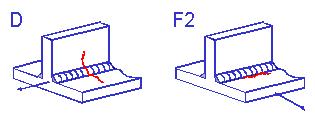
Two fillet welds are shown below. One is loaded parallel to the weld toe ( Class D ) and the other loaded perpendicular to the weld toe ( Class F2 ).
It is then assumed that any complex weld geometry can be described by one of the standard classifications.
Material Properties
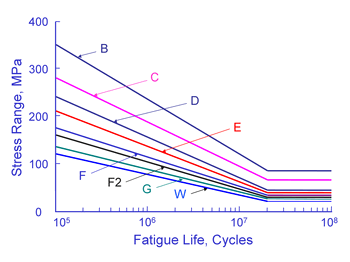
The curves shown above are valid for structural steel welds. Fatigue lives are not dependant on either the material or the applied mean stress. Welds are known to contain small cracks from the welding process. As a result, the majority of the fatigue life is spent in growing these small cracks. Fatigue lives are not dependant on material because all structural steels have about the same crack growth rate. The crack growth rate in aluminum is about ten times faster than steel and aluminum welds have much lower fatigue resistance. Welding produces residual stresses at or near the yield strength of the material. The as welded condition results in the worst possible residual or mean stress and an external mean stress will not increase the weld toe stresses because of plastic deformation. Fatigue lives are computed from a simple power function.

The constant C is the intercept at 1 cycle and is tabulated in the standard. This constant is much larger than the ultimate strength of the material.
The standard is only valid for fatigue lives in excess of 105 cycles and limits the stress to 80% of the yield strength. Experience has shown that the SN curves provide reasonable estimates for higher stress levels and shorter lives. In eFatigue, the maximum stress range permitted is limited by the ultimate strength of the material for all weld classes.
Design Criteria
Test data for welded members has considerable scatter as shown below for butt and fillet welds.
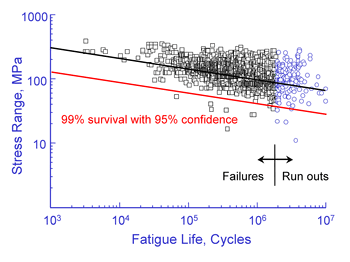
Some of this scatter is reduced with the classification system that accounts for differences between the various joint details. The standard give the standard deviation of the various weld classification SN curves.
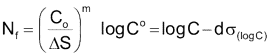
The design criteria d is used to determine the probability of failure and is the number of standard deviations away from the mean. For example d = 2 corresponds to a 2.3% probability of failure and d = 3 corresponds to a probability of failure of 0.14%.
© 2026 — Leading Matrix